The Foundation of Scientific Field Observation
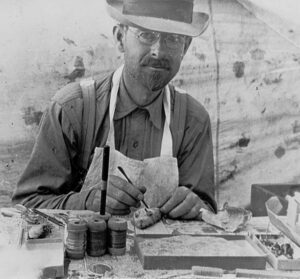
Dr. Joseph Grinnell (1877-1939) developed a field notation system for naturalists that revolutionized how scientists document observations. His method trained generations of researchers to see more, remember more, and record with precision.
Core Principle
Record only what you directly experience with your senses. No conjecture. No interpretation. No assumptions. Just the observable facts of the moment, captured as soon as possible.
Grinnell’s Rule: “No notes, no sleep” Write your observations immediately, even under difficult conditions. The longer you wait, the more memory rewrites what you actually experienced.
Standard Field Note Structure
- Date – When the observation occurred
- Time – Specific time of observation
- Location – Precise place (coordinates, landmarks, descriptions)
- Route – Path traveled to reach the observation site
- Weather – Temperature, cloud cover, wind, precipitation
- Observations – Detailed sensory data only
What to Record
- What you see, hear, smell, touch
- Colors, textures, sizes, distances
- Behavior (if observing animals)
- Specific details that distinguish this moment from others
- Conditions that might affect your observations
What to Exclude
- What you think something means
- Why you believe something happened
- Comparisons to past experiences (unless documenting change)
- Speculation about future events
Why It Works
- Sharpens attention: Regular practice trains your mind to notice details you would otherwise miss.
- Builds reliable records: Notes can be reviewed years later by you or other researchers.
- Separates observation from interpretation: Keeps raw data clean for later analysis.
- Creates institutional value: Grinnell’s own field notes are still used by researchers today, nearly a century later.
The Long-Term Benefit
Scientists who use the Grinnell system consistently report that their observational skills improve dramatically. They begin noticing patterns, details, and changes that were invisible to them before. The method trains perception itself.
For Research Institutions Field journals using the Grinnell system become permanent scientific records. Many institutions require field scientists to maintain these notes as a condition of employment and to hand them over upon completion of research.
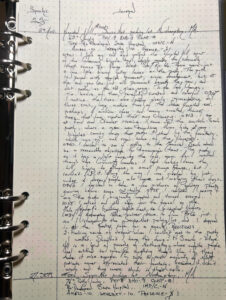
Legacy Grinnell’s field notes from the early 1900s are housed at the Museum of Vertebrate Zoology at UC Berkeley. Researchers still consult them to understand historical species distribution, behavior, and environmental conditions. Well-maintained field notes outlive their authors and continue serving science for generations.
The Standard for Field Science The Grinnell method remains the standard practice throughout field-deployed scientific communities. It has proven itself for over a century as the most reliable way to capture observational data.
Resources
- Field Notes class handout (PDF) is available through the Beginning Field Notes class.
Bibliography
“The ‘Grinnell’ Method.” Museum of Vertebrate Zoology, UC Berkeley. https://mvz.berkeley.edu/history/the-grinnell-method/.
Official documentation from the institution Grinnell founded and directed. Explains the four-component system: field notebook, field journal, species account, and specimen catalog. Includes Grinnell’s 1908 prediction that “our field-records will be perhaps the most valuable of all our results” and his 1910 emphasis that field documentation requires “even more time than would be required for the collection of the specimens alone.” Particularly valuable is the discussion of his 1912 article advocating for “first-person, narrative observations that defy ‘card-systems’ or other ‘cataloging’ styles of documentation”—showing Grinnell prioritized narrative quality over rigid formatting. The page documents how MVZ continues using his methods and references the Grinnell Resurvey Project, where researchers use his century-old field notes to document environmental changes. Essential for understanding the method at its source institution.
Canfield, Michael R., ed. Field Notes on Science and Nature. Foreword by Edward O. Wilson. Cambridge, MA: Harvard University Press, 2011.
This was the book that introduced me to scientific Field Notes—a collection of twelve essays by eminent field scientists sharing their actual notebooks and documentation methods. Contributors include George Schaller, Bernd Heinrich, Kenn Kaufman, and others, each revealing their observational techniques, materials, and field practices. Lavishly illustrated with reproductions of field journal pages, sketches, maps, and photographs showing how working naturalists actually document observations. Essential for understanding how vivid scientific writing emerges from rigorous field notation. Demonstrates that despite digital tools, handwritten field notebooks remain “the most basic tool for studying the science of nature.” Invaluable for writers wanting to see professional field notes in practice across different disciplines and approaches.
Herman, Steven G. The Naturalist’s Field Journal: A Manual of Instruction Based on a System Established by Joseph Grinnell. Vermillion, SD: Buteo Books, 1986.
The definitive instructional manual on Grinnell’s field documentation system. Herman explains the four-part method: field notebook (immediate observations), species account (specimen-level detail), collection catalog (systematic inventory), and field journal (expanded daily narrative). Essential for understanding how to implement Grinnell’s philosophy practically. Though focused on natural history, the system adapts directly to built environment documentation. Out of print and expensive, but remains the most comprehensive treatment of the method.
Grinnell, Joseph. “The Methods and Uses of a Research Museum.” Popular Science Monthly 77 (1910): 163-169.
Grinnell’s foundational essay establishing that field notes serve future researchers, not just the original observer. Argues for standardized, detailed documentation capturing context invisible to the note-taker but critical for later analysis. Essential for understanding why field notes require rigor beyond personal memory.
Harper, Dan. “A Field Journal for Naturalists.” 2021. https://www.danielharper.org/yauu/wp-content/uploads/2021/06/A_Field_Journal_for_Naturalists.pdf.
Practical guide to implementing Grinnell’s system with modern tools. Covers material selection (paper, pens), format specifications, and integration with digital platforms like smartphones. Includes examples from historical field journals and addresses common challenges. Accessible introduction for beginners while respecting the system’s rigor.
Long, Donna L. “Keeping a Naturalist’s Field Journal: The Grinnell Technique.” 2012. https://donnallong.com/wp-content/uploads/2012/10/grinnell-handout.pdf.
Accessible practical guide by a professional garden writer who successfully adapted Grinnell’s system for creative work. Includes observation checklists, formatting guidelines, and concrete tips for implementation. Explicitly permits reproduction for educational purposes. Long demonstrates how the method improves observational thoroughness and makes accumulated data actually useful for writing projects. Ideal introductory handout for workshop participants—much more accessible than Herman’s expensive out-of-print book while covering all essential components.
Codex / Grinnell Field Notes System