
Anansi is named for the West African trickster god of storytelling, often depicted as a spider weaving narratives. The mythology survived the Middle Passage and transformed across the diaspora—Anansi in Jamaica, Aunt Nancy in the American South. The spider catches what matters in its web.
The Anansi system adapts Grinnell’s scientific field notes by adding psychological fields to each entry, which forces your slow-thinking brain to interrogate experiences your fast-thinking brain would process automatically. This builds habits of measurement that extend beyond exploration into your daily life. That extension is both the value and the risk.
Extended Fields as Interrogation Tools
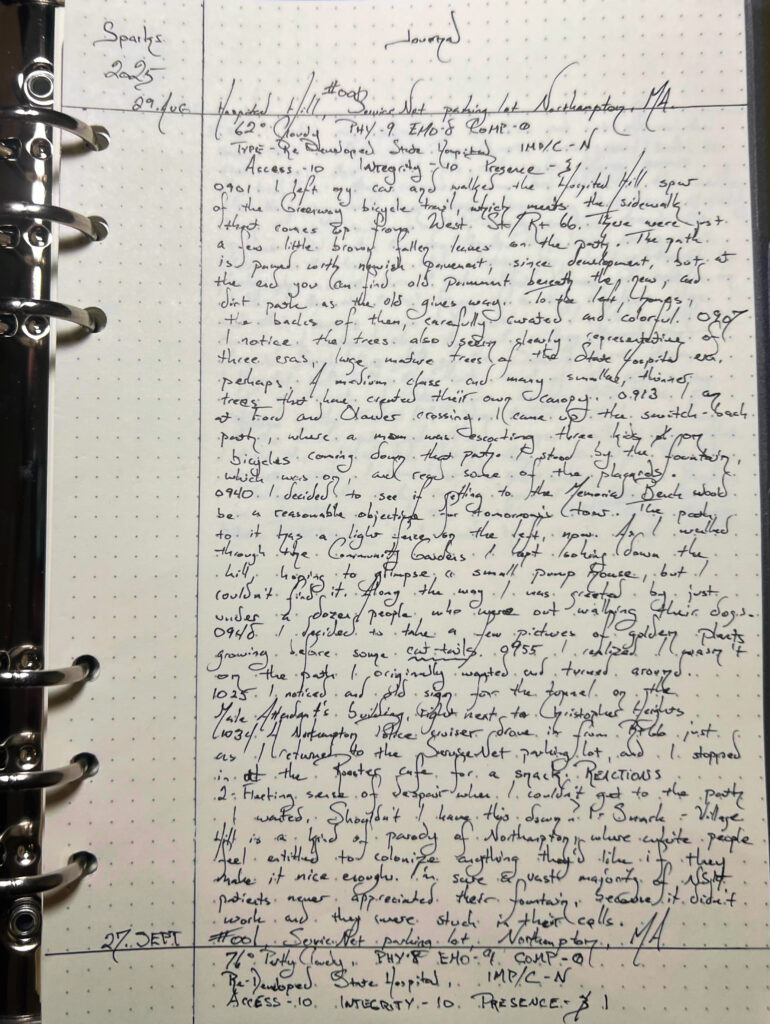
The psychological fields force your slow-thinking brain to examine experiences your fast-thinking brain would process automatically. When you assign a Reactions number (1-10) immediately after an observation, you’re capturing emotional data before Fading Affect Bias begins editing the memory. The act of quantifying forces you to pause and ask: “How strongly did this actually affect me?”
Through consistent use, measuring psychological weight becomes automatic. You start applying it everywhere—not just exploration. Relationships, career choices, creative projects. You develop the reflex of asking “how much mass does this carry?” and “how much time am I actually investing here?” This is where destabilization can occur: aspects of the mythology you’ve built about yourself may collapse when confronted with measurement.
Bibliography
Kahneman, Daniel. Thinking, Fast and Slow. New York: Farrar, Straus and Giroux, 2011.
Establishes the dual-process theory (System 1/System 2 thinking) underlying Anansi’s separation of observation from interpretation. Kahneman’s framework explains why field notes must capture raw sensory data before fast thinking generates narrative explanations. The “outside view” methodology directly informs Anansi’s use of quantified emotional tracking to problematize automatic narrative construction.
Mueller, Pam A., and Daniel M. Oppenheimer. “The Pen Is Mightier Than the Keyboard: Advantages of Longhand Over Laptop Note Taking.” Psychological Science 25, no. 6 (2014): 1159-1168.
Demonstrates that longhand note-taking produces superior conceptual understanding compared to laptop typing across multiple experiments. Students who wrote notes by hand performed better on conceptual questions despite taking fewer notes. Critical evidence for Anansi’s requirement that field notes be handwritten – the cognitive processing during handwriting itself enhances observational depth and memory consolidation.
James, Karin H., and Laura Engelhardt. “The Effects of Handwriting Experience on Functional Brain Development in Pre-literate Children.” Trends in Neuroscience and Education 1, no. 1 (2012): 32-42.
FMRI studies showing handwriting activates broader neural networks than typing, particularly in brain regions associated with reading circuits and memory formation. Provides neurological basis for why handwritten field notes create more durable memory traces than typed equivalents. The sensorimotor integration during handwriting fundamentally differs from keyboard input at a neurological level.
Longcamp, Marieke, et al. “Learning Through Hand- or Typewriting Influences Visual Recognition of New Graphic Shapes: Behavioral and Functional Imaging Evidence.” Journal of Cognitive Neuroscience 20, no. 5 (2008): 802-815.
Documents how the motor act of handwriting creates stronger visual memory traces than typing. Participants who handwrote new characters showed superior recognition compared to those who typed them. Supports Anansi’s emphasis on handwritten observation – the physical act of forming letters enhances visual encoding of what’s being documented.
Mangen, Anne, and Jean-Luc Velay. “Digitizing Literacy: Reflections on the Haptics of Writing.” Advances in Haptics (2010): 385-401.
Examines the haptic feedback and spatial-temporal aspects of handwriting that typing eliminates. The physical relationship between hand, pen, and paper creates embodied cognition that keyboard input cannot replicate. Relevant to understanding why Anansi field notes must be analog – the methodology depends on neurological processes activated specifically through handwriting.
Codex / Anansi