Exploration is the deliberate entry into unknown or unverified territory for the purpose of producing knowledge. It is not tourism. It is not an adventure for its own sake. The explorer goes to a place with a method, applies that method under conditions of uncertainty, and returns with a record. What separates exploration from wandering is accountability to the record — the commitment that what happened in the field will be documented with enough precision that someone who was not there can understand what was found, and that the explorer herself can return to the record later and trust it.
Urban exploration is exploration conducted in built environments — specifically in the spaces cities produce and then abandon, suppress, or forget. Tunnels, rooftops, decommissioned infrastructure, shuttered institutions, contested ground. The practice emerged in the twentieth century alongside the industrial city itself, as cities began generating ruins faster than they could process them. What the urban explorer enters is not wilderness but a particular kind of human remainder: the built thing that has outlasted its official purpose and been left to decay outside public view.
Urban exploration has always had a documentation ethic at its center, even when that ethic went unstated. The photographer climbs to the roof not only to see the view but also to bring it back. The tunnel walker makes a map. The record is the point. Without it, the mission produces only a private experience — valuable perhaps, but not knowledge in the transferable sense. The document is what transforms the body’s passage through a space into something usable by others.
Carl Akeley and the Taxidermist’s Method
To understand what the Autumn Society does differently, it helps to examine what natural history documentation looked like when modern fieldwork was born — and what was wrong with it from the start.
Carl Akeley was the most accomplished taxidermist in American history. Working primarily between the 1880s and his death in 1926, he revolutionized the craft from crude stuffing into a sculptural art form indistinguishable from life. His masterwork was the African Hall at the American Museum of Natural History in New York, opened in 1936 and still standing. It remains one of the most visited spaces in one of the world’s most visited museums.
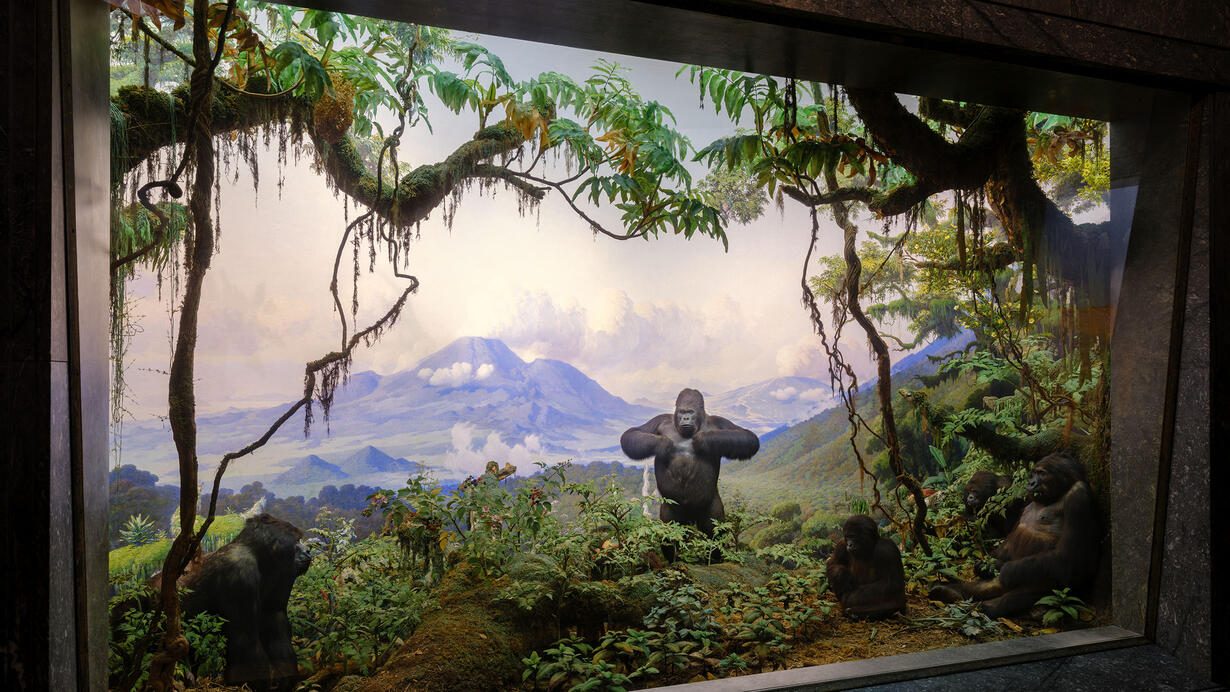
Akeley went to Africa repeatedly. He observed animals in the field with extraordinary care and patience. He killed them, transported their skins and skeletons to New York, and rebuilt them there in poses he had studied in life. He surrounded them with meticulously reproduced habitat — exact plants, exact soil, exact rock — set against panoramic paintings of specific African landscapes. The result was what he called a “peephole into the jungle”: a vision of Africa so convincing that it seemed more real than Africa itself. The gorilla he mounted for the central diorama was killed in 1921. He died five years later on his last return expedition and was buried on the slopes of Mt. Mikeno in the Congo, the site he had chosen for the gorilla’s final pose. His grave and the diorama share a geography.
Donna Haraway’s 1984 essay “Teddy Bear Patriarchy: Taxidermy in the Garden of Eden, New York City, 1908–1936” argues that Akeley believed he was making a record of Africa. He was not. He was making a record of what white, male, industrial America needed Africa to be: a place of originary purity, frozen at the moment before civilization arrived to corrupt it. The diorama presents this Africa as truth — unmediated, transparent, a window onto nature at its highest perfection — while concealing every act of construction that produced it. Haraway’s phrase for the entire apparatus is Teddy Bear Patriarchy: the commerce of power and knowledge operating under the cover of natural history.
Three things about Akeley’s method are worth holding onto.
First, the knowledge it produces requires the subject’s death. The gorilla in the diorama is more perfect than any living gorilla — musculature exact, gaze perpetual, pose composed for eternity. But it is perfect because it is dead and because its interior has been removed. Taxidermy is the art of keeping the surface while evacuating the inside. What the visitor sees in the diorama is a skin stretched over a wire-and-clay armature. The animal’s actual body — its weight, its smell, its biological specificity — was discarded as irrelevant to the record.
Second, the method claims neutrality it cannot possess. Akeley’s dioramas present themselves as unmediated visions of nature. But every element was chosen: which animals, which pose, which moment in the group’s life to freeze, which landscape to paint behind them. The selection was made by a white American taxidermist working in the context of eugenics, imperialism, and the specific anxieties of early twentieth-century New York. Haraway points out that Akeley’s gorilla was killed the same year the American Museum of Natural History hosted the Second International Congress of Eugenics. The diorama does not mention this. The diorama mentions nothing. It presents itself as nature speaking.
Third, and most important: the method produces a particular kind of memory. The visitor leaves the African Hall having experienced Africa — specifically, the Africa that Akeley and his patrons needed to exist. That memory is durable, authoritative, and false. It is a product manufactured through a specific process by specific people with specific interests. The visitor does not know this. The method is designed so they will not know it.
Joseph Grinnell and the Field Note
In the same decade that Akeley was perfecting the diorama, a zoologist named Joseph Grinnell was developing a radically different documentation method at the Museum of Vertebrate Zoology at the University of California, Berkeley.
Grinnell’s system was built for field naturalists studying birds and mammals in their living environments. It was not concerned with specimens for display. It was concerned with the record of encounter: what the observer saw, heard, measured, and inferred in the field, written down immediately and completely, before memory had a chance to organize and simplify what happened.
The system produced four kinds of documents — a field journal, species accounts, a catalog, and specimen records — that together captured not only the data but the conditions under which the data was gathered. The observer’s position, the weather, the time, the behavior of the animal in context, the habitat, and the observer’s uncertainty where uncertainty existed. Grinnell insisted that field notes be written in the field, not reconstructed afterward. He understood that memory is not a faithful recording device. It is a processing device. It compresses, emphasizes, and discards according to patterns that the observer does not consciously control. Notes taken at the moment of observation capture something that reconstructed notes cannot: the event before the processing begins.
Grinnell’s method placed the observer inside the record rather than outside it. The naturalist’s position, limitations, and judgments were documented alongside the animal’s behavior. The record was honest about its own construction in a way that Akeley’s diorama could never be.
The contrast between the two methods is not merely technical. It is epistemological. Akeley’s method produces a permanent object that claims to speak for nature directly. Grinnell’s method produces an accountable document that claims only to record one observer’s encounter with nature, at a specific time and place, under specific conditions. One method evacuates the observer to create the illusion of transparent truth. The other keeps the observer in the frame, which is the only honest position available to any instrument of knowledge.
The Anansi System
The Autumn Society’s field documentation method, called the Anansi system, inherits Grinnell’s logic and extends it.
Where Grinnell’s method tracks the observer’s physical position and sensory observations, the Anansi system adds a psychological dimension. The field note contains not only what the explorer saw and measured but what she felt — specifically, what she felt before the Fading Affect Bias could begin its work.
The Fading Affect Bias is a well-documented pattern in human memory: emotional responses to events fade faster than factual memories of those same events. Within hours or days of an experience, the emotional charge diminishes while the narrative account stabilizes. The Grinnell method, applied at the moment of encounter, captures observation before narrative can compress it. The Anansi extension captures emotional response before the fade can compress it. Together, they produce a field note that retains what standard documentation discards: the weight of the event as it was actually experienced by the body present.
The Anansi system’s two field note categories — Observations and Reactions — require the explorer to record not only what she documented but how the space felt. Observations cover what was seen, heard, measured, and clearly notes what has been inferred. Reactions cover the emotional and somatic response to the encounter: what the body registered that the eye did not classify. The two fields work together. Neither is optional. The structure is deliberately simple and rigid, because it must be repeated the same way every time to be trusted.
The field note the primary artifact of every Autumn Society mission. The photograph is in service of it. The Form B documentation is in service of it. The campaign report is in service of it. The field note is what the mission produces, and the field note is what persists.
The method also refuses the false neutrality that Akeley’s approach depended on. There is no pretense that the Autumn Society explorer is a transparent instrument through which the site speaks. The explorer is a specific person — located historically, emotionally, racially — and those specificities are part of the record. The record does not conceal its own construction. It documents it. This is not a weakness of the method. It is the method’s central ethical commitment.
Memory is a product. The Akeley method produces one kind of memory: Africa as origin, as purity, as the raw material for someone else’s story about regeneration. The Anansi method produces a different kind: the explorer’s encounter with a specific site, held in enough detail that the encounter can be returned to, interrogated, and understood more fully over time than it could be understood in the moment. The product belongs to the explorer who made it. It is not extracted and transferred to another institution. It stays.
What the Colonial Form Cannot Hold
Modern fieldwork by academic and other knowledge-producing groups demands several layers of preparatory protocol to align the explorer’s planned presence with the material needs of their patron colonial knowledge manufactories. The academic expedition apparatus — the IRB protocol, the ARCCH permit, the NSF Safe and Inclusive Fieldwork Plan, the Material Transfer Agreement — is the Akeley method deployed at a bureaucratic scale. Before the expedition departs, the forms ask the researcher to estimate the quantity and volume of materials expected to be recovered. This is not an administrative inconvenience. It is ontology. The form decides in advance what a recoverable object is. What cannot be classified, weighed, and transported does not count. What does not fit the form does not exist.
The form produces its own memory: the memory of Africa (or any other site) as a collection of extractable materials, cataloged by instruments external to the place, for the benefit of institutions that were not there. The emotional experience of the person who stood in the space is not a recoverable object. It is noise. It is discarded.
The Anansi system refuses this logic at the instrument level. Its primary artifact — the field note written in the field, by hand, tracking observation and emotional response simultaneously — is exactly what the permit form cannot accommodate. It cannot be quantified in advance. It cannot be shipped. It does not belong to any institution other than the explorer who made it. It is, in the vocabulary of heritage bureaucracy, non-recoverable material. This is precisely its value.
The colonial training that produced academic expedition methodology did not make sense for the individuals subjected to it. Black scholars trained in the methods of natural history, anthropology, and archaeological survey were trained in tools designed not for their benefit but for the benefit of the projects that employed them. The training made sense for the colonial social project. It made very little sense for the people from whom the colonial project was extracting knowledge. Anansi makes this visible. An explorer who applies the full method — who tracks her reactions, who writes the field note in the field and returns to it weeks later — begins to notice the shape of what she was trained to suppress. The pre-FAB record is diagnostic. It shows the gap between what the body registered and what the official account would have reported.
The Analog Cyborg
In “A Cyborg Manifesto,” Donna Haraway argues that the most powerful form of resistance available to those marked by Western systems of domination is not a return to an imagined pre-colonial wholeness but the seizure of the tools that did the marking. She writes that cyborg writing is about the power to survive “on the basis of seizing the tools to mark the world that marked them as other.” The cyborg does not need an origin story. It does not claim innocence. It claims the tools.
The Autumn Society explorer is an analog cyborg in this sense. She has no claim to a pre-colonial purity. She does not enter ruins to recover a lost Black past that was whole before the ruins were made. She enters the ruins as herself — specifically herself, with a specific history, tracking her specific reactions — and produces a knowledge product that the colonial system that made the ruins has no category for.
She is analog because the instrument is her body, the record is handwritten, and the method is human rather than digital. She carries a notebook, a rangefinder, a camera, and a watch, and uses them to produce a field note documenting her presence in the space with as much precision as she can manage. The precision is not in service of abstraction. It is in service of fidelity: to the site, to herself, to the community that sent her.
The Autumn Society trains explorers to use this instrument. The training is not primarily technical, though technical skills are required. It is epistemological: the explorer is learning to understand her own body as the primary instrument of knowledge, to trust its registrations rather than immediately processing them into narrative, and to produce records that keep rather than discard what she felt. In doing so, she is refusing — at the level of method, before any argument is made — the logic that made Akeley’s gorilla more real than a living gorilla and that made the permit form more important than the person who fills it out.
Urban Literacy
The Autumn Society’s version of urban exploration is organized around a doctrine called Urban Literacy: the capacity to read a place — to understand what it has been, what it is, what it is refusing to say, and what its silences mean. It is not enough to enter a site and feel something or to merely make an image. The explorer must be able to carry the knowledge back: to translate the encounter into a record precise enough to be useful, shared without compression, and added to the community’s cumulative intelligence.
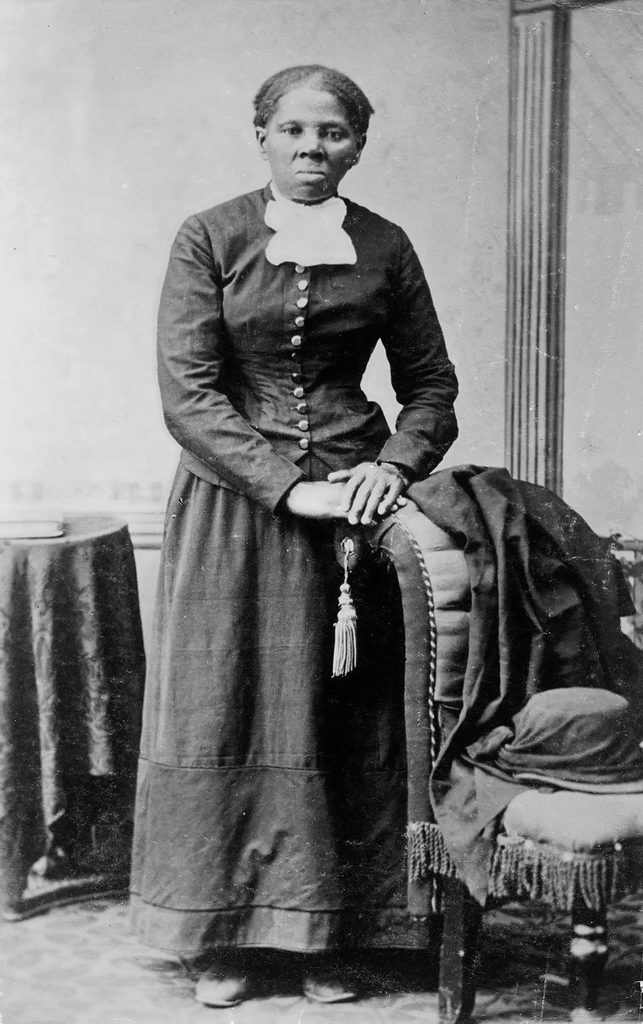
The Autumn Society traces this practice to Harriet Tubman, who used her intimate knowledge of the landscape — its roads, water, cover, and timing — to guide people through hostile territory to freedom. Tubman conducted reconnaissance. She ran scouts. She planned routes under operational conditions where the cost of error was death or re-enslavement. When she led the Combahee River Raid in June 1863, guiding Union gunboats through Confederate positions using intelligence she had gathered personally, she became the first American woman to oversee military action in a time of war and freed more than 750 people from enslavement in a single night. She demonstrated that the Black body’s knowledge of a landscape is a military asset—a form of intelligence that the people who controlled that landscape had systematically failed to recognize. In November 2024, more than 150 years after her service, the Maryland National Guard posthumously commissioned her as a one-star brigadier general. The institution finally caught up.
This is what the mission produces. Not the ruin photograph posted online, stripped of context. Not the thrill of trespass, privately held. Not a paper delivered to an institution that will archive it somewhere inaccessible. A field note. An intelligence product. A document authored by the body that was there, for the community that will not be there, kept rather than discarded, available to anyone it belongs to.
The Autumn Society explores sites of Black history (though not exclusively). It goes to prisons, hospitals, houses, street corners, tunnels, and fields where something happened that the official record has thinned or erased. It applies a method that refuses to thin or erase. It produces a record that names what the body registered, insists on its own partiality, and trusts that partiality more than any claim to transparent truth.
Akeley mounted the gorilla to save it from time. The Autumn Society enters the space to be changed by it. That is the difference between the diorama and the field note. One preserves the surface and discards the interior. The other keeps the interior and lets the surface change.
Sources
Haraway, Donna. “Teddy Bear Patriarchy: Taxidermy in the Garden of Eden, New York City, 1908–1936.” Social Text, No. 11 (Winter, 1984–1985), pp. 20–64. https://www.jstor.org/stable/466593 Duke University Press. The foundational analysis of Akeley’s African Hall as a production of racial, sexual, and class ideology disguised as natural history. Haraway’s argument that “Akeley is America’s biographer” — not Africa’s — is the lens through which Autumn Society reads the entire tradition of colonial knowledge production.
Haraway, Donna. “A Cyborg Manifesto: Science, Technology, and Socialist-Feminism in the Late Twentieth Century.” In Manifestly Haraway. https://archive.org/details/anarchy_Cyborg_Manifesto_Harroway/ University of Minnesota Press, 2016. First published 1985. The argument that the most productive political identity for those marked by Western domination is not a return to origin but a seizure of the tools. The cyborg who survives “on the basis of seizing the tools to mark the world that marked them as other” is the theoretical ancestor of the Anansi explorer.
Grinnell, Joseph. “Field Tests of Theories Concerning Distributional Control.” The American Naturalist, vol. 51, no. 602, 1917. The source method. Grinnell’s insistence on immediate, handwritten, non-interpretive field notes — produced in the field, not reconstructed from memory — is the documentary foundation of the Anansi system. His understanding that notes taken at the moment of observation capture something that no retrospective account can recover is the premise on which pre-FAB tracking rests.
Osho-Williams, Olatunji. “Harriet Tubman Just Became a One-Star General, More Than 150 Years After Serving With the Union Army.” Smithsonian Magazine, November 13, 2024. https://www.smithsonianmag.com/smart-news/harriet-tubman-just-became-a-one-star-general-more-than-150-years-after-serving-with-the-union-army-180985458/ Documents the posthumous commissioning of Tubman as a one-star brigadier general in Maryland’s National Guard, and confirms her service as spy, scout, nurse, and cook, and her role commanding the Combahee River Raid — the first military operation in American history planned and led by a woman.
Codex / Urban Literacy