
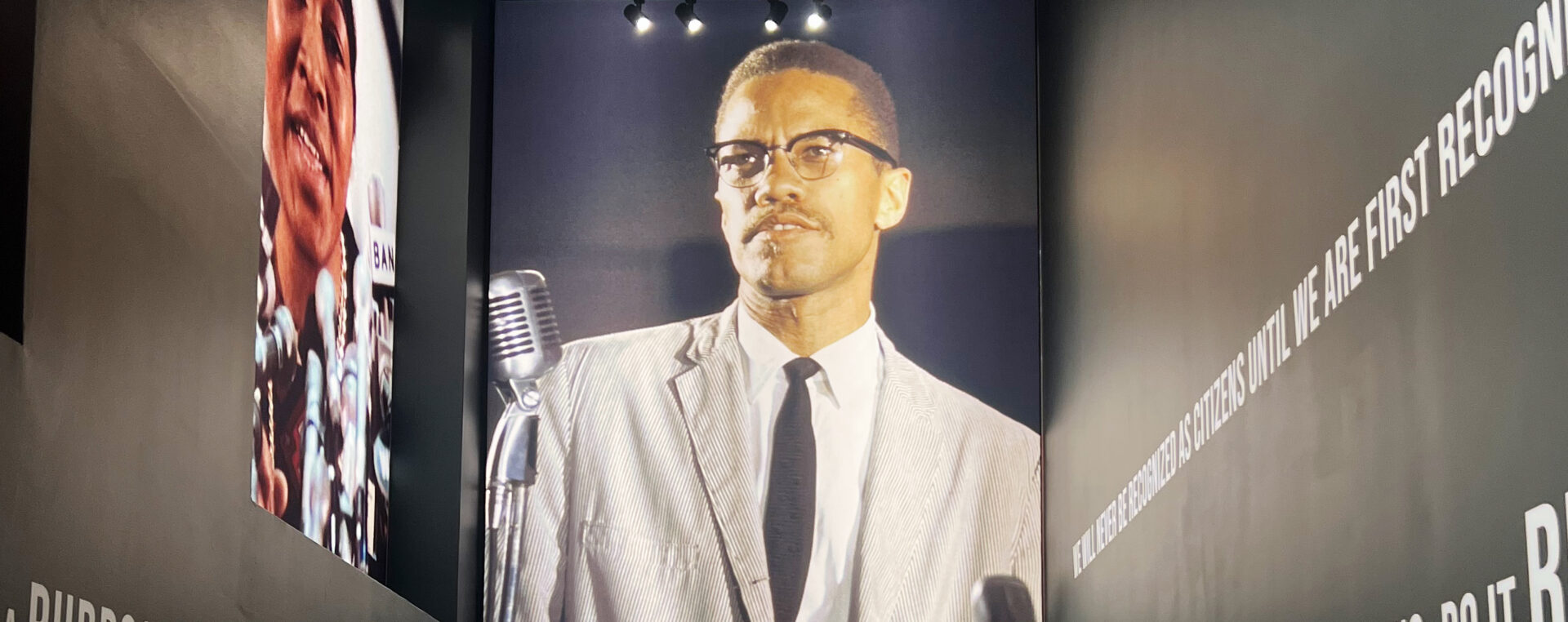
This year was the sixty-first anniversary of the death of Malcolm X. The event takes place every year at what was the Audubon Ballroom, now the Malcolm X and Dr. Betty Shabazz Memorial and Educational Center. The night was warm for February, and New Yorkers had enjoyed their first 50-degree day; there seemed to be a lot of people milling about Harlem that night. Police were directing traffic, and the line to get into the ballroom stretched back a ways.
The foyer was amazing: High ceilings, a statue of Malcolm, perhaps in bronze. There were tables set up for tickets, and press, that sort of thing. On the walls, images of Malcolm’s life, with captions that talk through his experiences and evolution.
Upstairs, an array of chairs on either side, terminating at a stage set up on the far side. To the right are windows facing the street. The historian in me wondered if the orientation of the room was the same today as it had been, because it seems natural that it would be, given the location of the stairs. If so, the stage could be in the same place it was, though much smaller and temporary, and the chairs would be facing in the same direction, too.
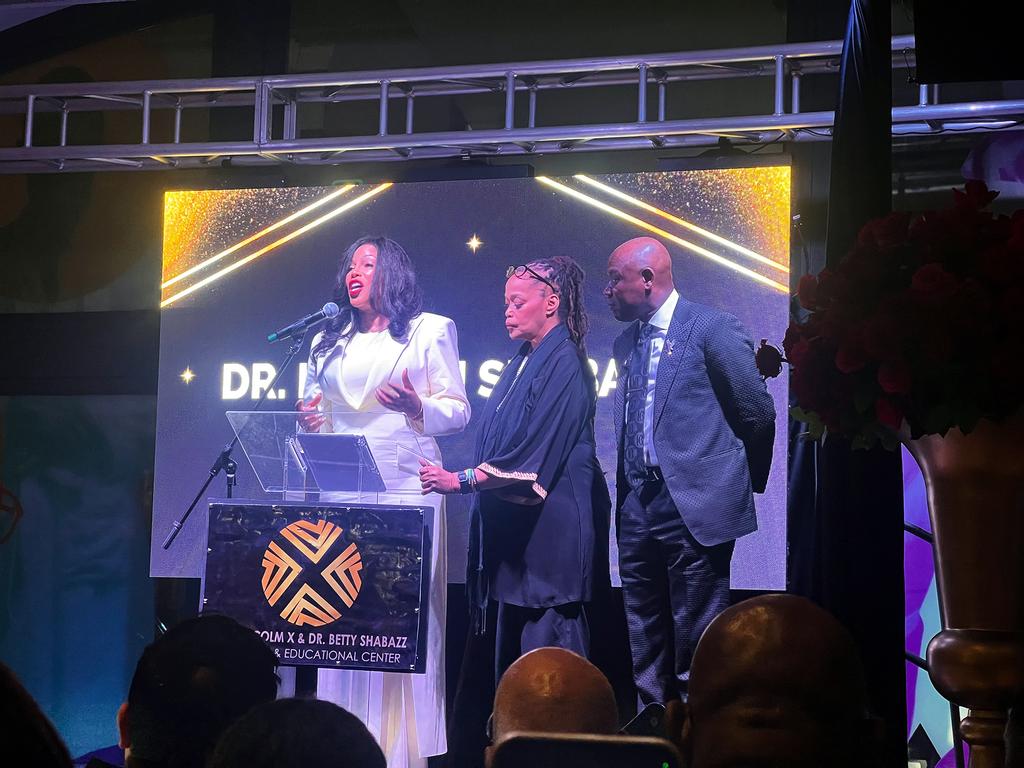
The event begins with an award and ceremony for Ayanna Gregory, Dick Gregory’s daughter. Later, I don’t recall what was going on on stage in the moment, but I turn to my left and a tall white dress is striding between the chairs, moving up to the stage. When this person gets on stage and turns to face the audience, I can see Malcolm in her face. Dr. Ilyasah Shabazz has a similar forehead and her dad’s sugar smile.
I was just a child when Spike Lee’s movie brought Malcolm’s life to the silver screen. I had buried my father the year before, and what I recall most vividly was how Malcolm scared me. I grew up in Northampton, Massachusetts, where Black people account for 2% of the population, and so I had only heard two Black men raise their voices. Black righteous anger was entirely new to me, and I was simply too young and too traumatized to know the difference between expression and abuse.
I realized sometime later, perhaps in my 20s, that the image of my dead father in my head is actually Malcolm X, purely on account of timing. I never saw the pictures of my father’s body, so my mind simply referenced the only other Black male body it had seen still, like that.
A few years back, there was an ad of some sort floating around the net that featured Black leaders in nature. The images were clearly altered; they were made to pass as real, but it struck me that I had never seen Black leaders outside of the framing of white supremacy. Imagery of Malcolm, for example, was of his life in the US, or his travels abroad, which are framed by white supremacy because they are merely outside its physical mass. To be physically outside a thing is not necessarily to be free of it.
Nature, on the other hand, is an entirely separate order. I would have loved to have gone hiking with Malcolm X. I am sure we would have had plenty to talk about. I would have shown him the Ledges, McLeod Lake, and Chapel Falls.
This is where the idea of the Autumn Society was born. Valley Society was a writing experience that represented an impressive diversity of perspectives across the Black diaspora. The Autumn Society extends the Valley Society project with a dedicated framework for building observation skills through experiences in nature. This framework is then utilized in urban exploration of the Black experience.
Autumn Society
Campaign 1: Mission X.
The Autumn Society runs on small funding and serious work. If this matters to you, please consider supporting our next retreat.

