
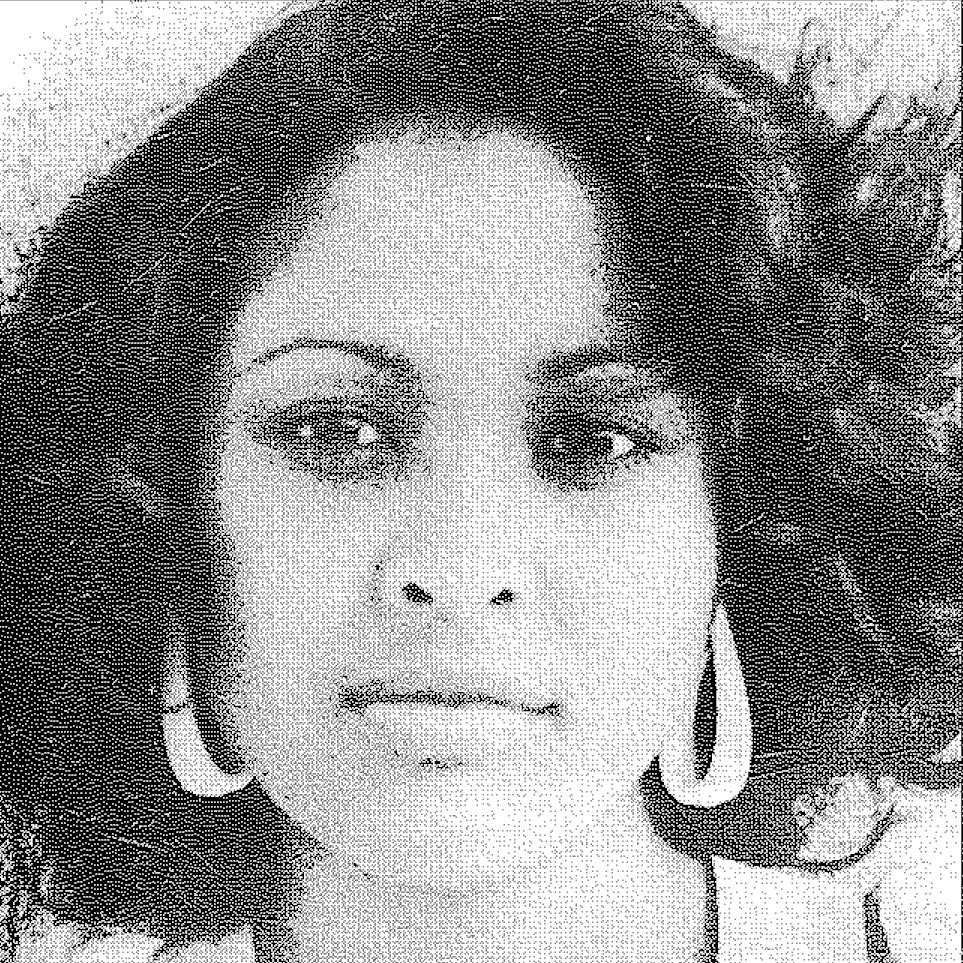
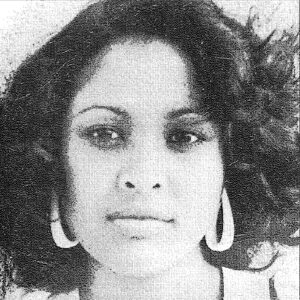
Seta Rampersad, a student at the University of Massachusetts, Amherst, died in the presence of at least three other people on September 13, 1978. Seta, the only person of color in the group, died at some point between leaving the Captain’s Table in Northampton just before 1:30 a.m. and when she was discovered by paramedics twelve hours later. The cause of Seta’s death was stated as respiratory failure, but what caused it has never been established. No one was held responsible for her death, not for failing to seek any medical intervention while she died, and not for abandoning her for the paramedics to find her naked and bruised body, alone.
This article is possible because of the work of reporters who pursued Seta Rampersad’s story when the institutions responsible for it had closed the file. The Valley Advocate published an investigation by Geoff O’Connell, Bev Eaton, Gary Nielson and Linda Matys based on the 647-page inquest transcript in March, 1979. When the Daily Hampshire Gazette criticized the Advocate in June, and the Advocate responded with an editorial in defence of its methods. VMag was the next to carry this case, with their 22 page report filed by David Biederman in 2000, which include Seta’s mother Pearl and her sister Sandy. Without these pieces of journalism this story would be much less than it is today.
Room 240
According to testimony, in the early hours of Wednesday, September 13, 1978, Seta Rampersad finished her shift as a waitress at the Captain’s Table, a popular dance and dinner spot on Damon Road in Northampton. Seta had taken the job after her financial aid package had been reduced. Seta wanted to become an international relations lawyer to help people migrate to the U.S., as her parents had. It was after midnight, and the buses did not run late. It was also a school night, so Seta had a textbook. She was two classes away from finishing her degree.
Demetrios Konstantopolous (40), also known as Jimmy the Greek, was a frequent guest of The Captain’s Table in Northampton and was friends with the owner. Seta had met Jimmy three months prior, and he had driven her home a few times before. According to him, they had snorted cocaine and danced together, but Jimmy didn’t know Seta’s last name. Jimmy was drinking vodka and soda, waiting for Seta to finish her shift, when Brian Pitzer (24) and Carol Newton (33) arrived. Jimmy owned the Castaway Lounge, a strip bar just down the road in Whately. Brian was unemployed and an alcoholic who had gotten into trouble with the law a few times, including an incident where he stole a rifle and then accidentally shot himself in the leg. At one point, he had lived in a farmhouse across from Castaways, but Jimmy and Brian did not know each other well; Brian had only been an occasional customer at Castaways. Carol was an assistant cook at Northampton State Hospital with a penchant for taking souvenirs. Carol and Brian finished a bottle of wine at Packards in Northampton before heading to the Captain’s Table.
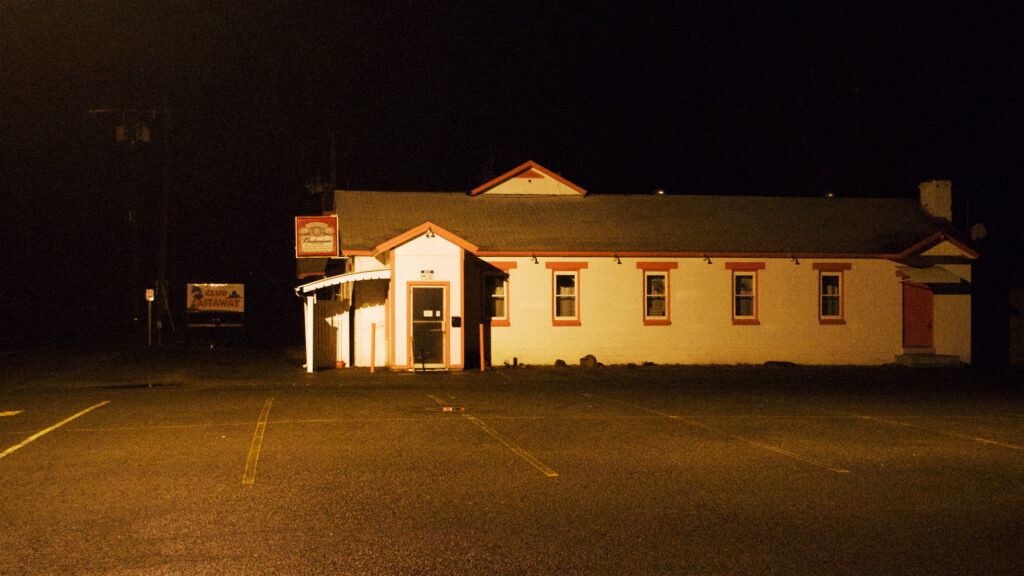
After closing time at the Captain’s Table, sometime before 1:30 a.m., the four left for the Castaway Lounge to continue their party. Castaways was officially closed by that time, too, so when there was a knock at the door around 1:45 a.m., the party decided to relocate the Deerfield Motel 6 (today Red Roof Inn), just a few miles further down Routes 5 and 10, arriving between 2 and 2:30 a.m.
According to testimony, the woman at the night desk said that Jimmy requested a room with two double beds, though he claimed to have been alone. Jimmy was assigned to room 240.
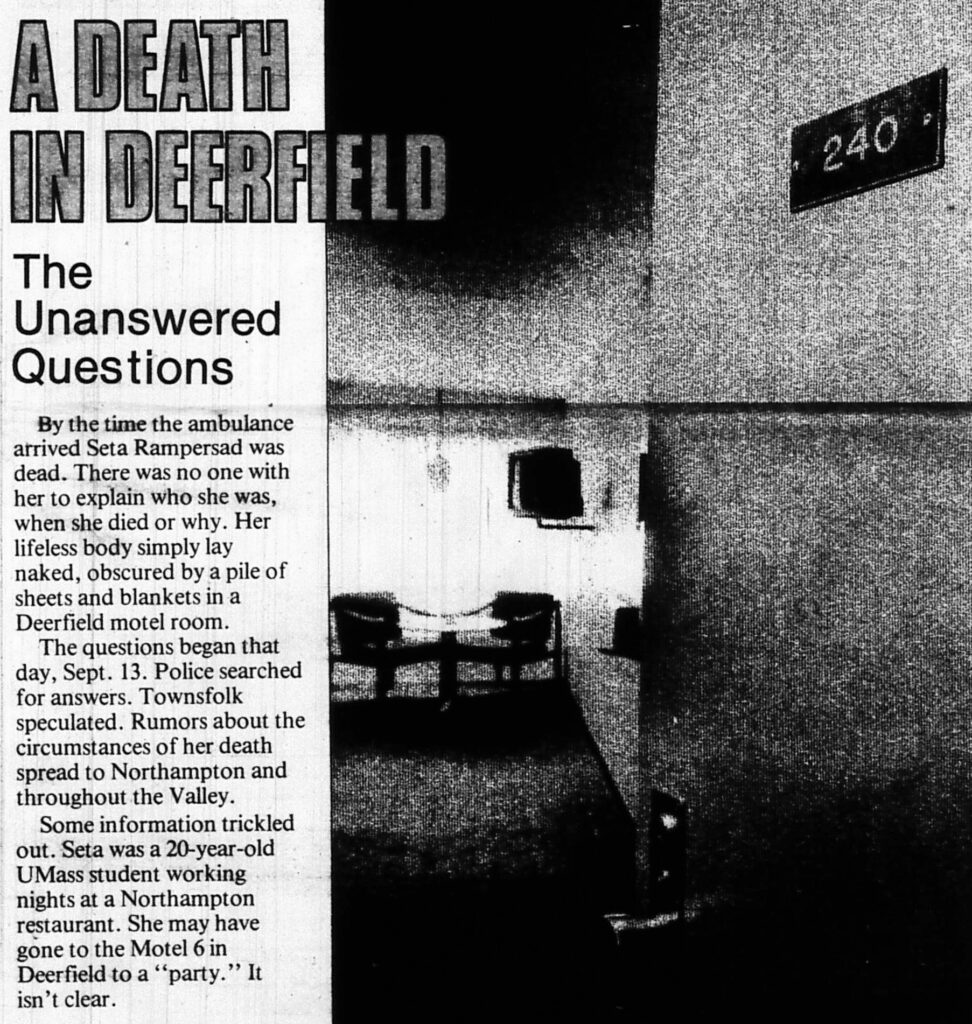
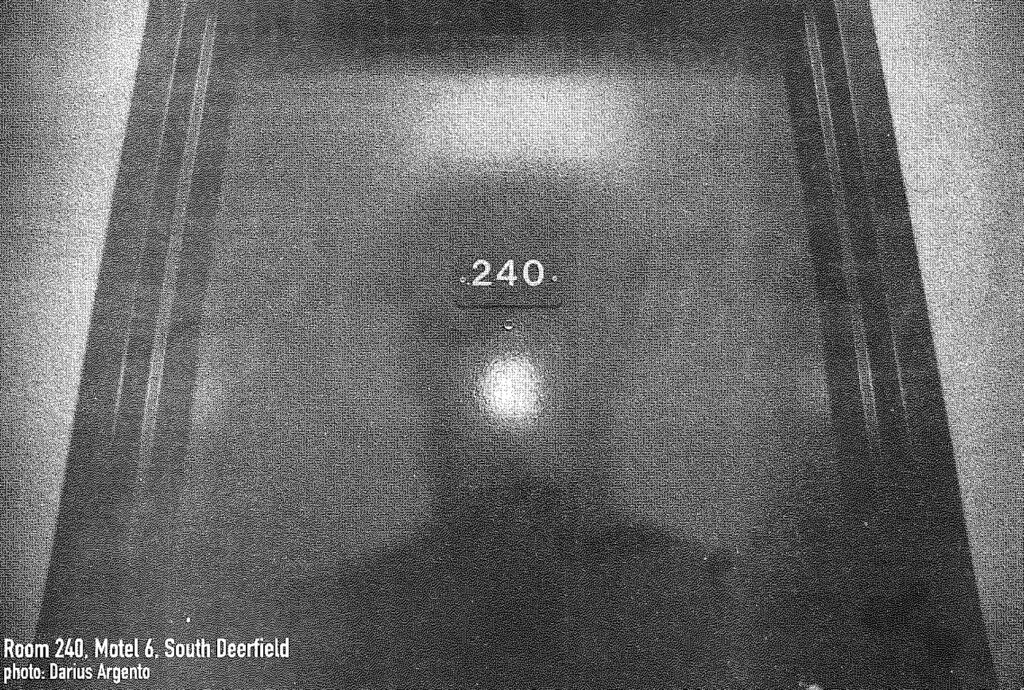
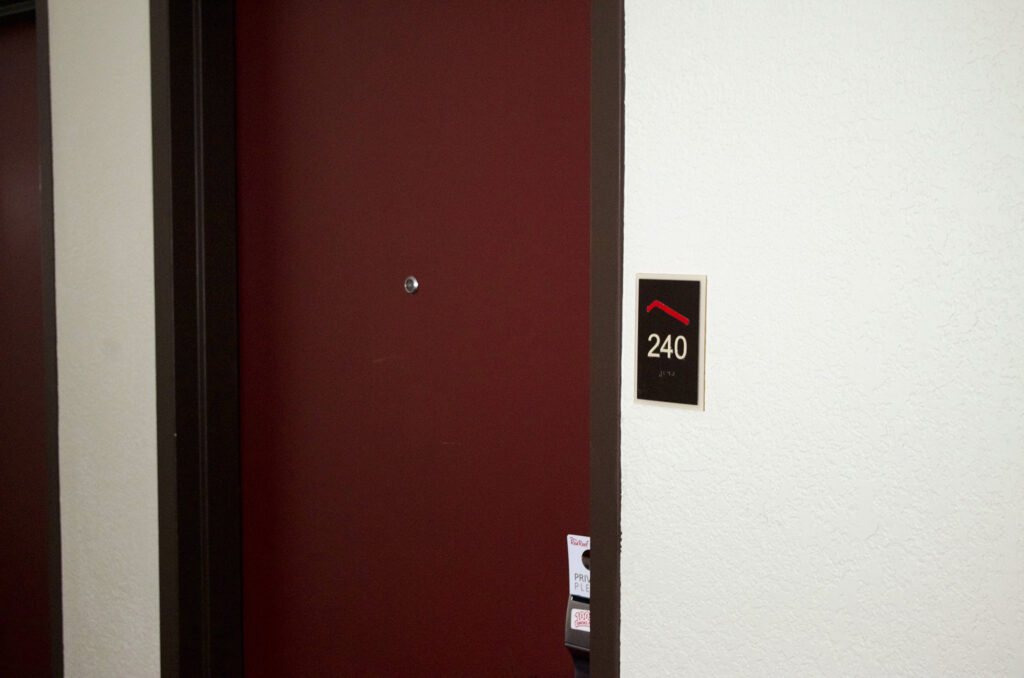
Carol testified that as soon as they entered the room, Jimmy had taken off his pants, which made her uncomfortable.
Testimony on precisely how much drugging was done varies widely between each account of the three witnesses to Seta’s death. According to Jimmy’s testimony, they all snorted coke. According to Brian, Jimmy and Carol snorted coke, but Seta did not, and when asked about his own cocaine use, Brian pleaded the 5th. Carol said that they all snorted coke and smoked pot and that Brian had supplied both. There was consensus that everyone had been drinking.
The group then paired off, with Seta and Jimmy, and with Carol and Brian, and each couple went to bed. There was an odd shower moment where Carol and Brian were in the shower and Jimmy dragged Seta in by the arm, proposing a foursome, which was refused.
Jimmy claimed Seta woke him up when she began experiencing seizures. Before this moment, Seta had never had any medical history or experience related to seizures or epilepsy, nor had the Rampersad family. Jimmy woke Carol, who thought Seta appeared to be sleeping and went back to sleep herself. Jimmy woke Carol again: “Seta was shaking all over, her legs were stiff, her lips were purple, and her fingertips were cold. Her eyes would roll up in her head, then come back down” (VMag June/July 2000). Jimmy slapped Seta a few times to make her stop. Carol felt Jimmy was slapping Seta too hard and testified that he seemed to become angry with Seta. Carol tried to wake Brian, but he was drunk and high and did not respond.
There were at least two episodes of what Jimmy and Carol described as seizures, each lasting about ten minutes. Carol wanted to call an ambulance, but Jimmy refused any outside help.
Suppression
In the simplest explanation, racism is a kind of objectification, dehumanizing someone to the extent they are more an object than a person. To this end, people of color are often portrayed as more animal than human. Hyper-sexualization of brown and black bodies also trends toward the dismissal of their experiences and the suppression of their voices.
In Seta’s case, her body, dead or alive, was so objectified and yet simultaneously central to the discussion of guilt that no one in the motel room, few in the courtroom, nor many in the press gave much, if any, consideration to her intent, what she was thinking or her voice, other than that she may have at some point had sex. Once Seta crossed the line from being a good girl to a sexual woman, she became more of an animal or thing than a person in the eyes of the last people to see her alive and, later, the court.
Dawn
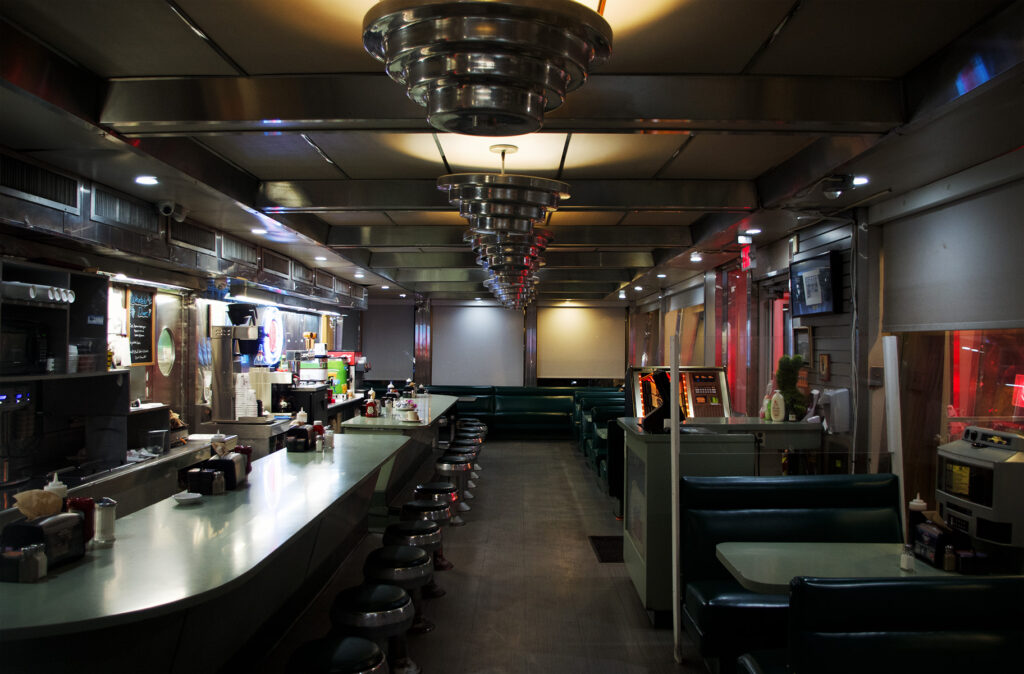
Carol and Jimmy testified that they traveled to Whately Diner for breakfast at some point around dawn, leaving Seta and Brian asleep in the motel room. Testimony regarding what time varied between witnesses. In Jimmy’s account, it was still dark outside when they left, but in Carol’s testimony, she remembered that it was light outside. Jimmy ate, but Carol did not.
Brian and Seta were still asleep when Carol and Jimmy returned, but Seta began having another seizure. Both attempted to rouse Brian again, but he remained out cold again. Jimmy may have tried to give Seta coffee from the diner, which she may have spit out. According to Jimmy, he brought Seta to the shower and ran cold water over her for about five minutes. Seta began moaning, the first time she made sounds since her episodes started. In carrying Seta back to the bed, Jimmy testified that he had slipped and dropped Seta on the ground. Later, Jimmy would bring Seta back to the bathroom again to induce vomiting with two of his fingers to clear her air passage, which she did.
At some point, Jimmy placed a spoon in Seta’s mouth to prevent her from biting her tongue. Carol was standing in the doorway when he was trying to insert the spoon. Brian woke when Seta was being carried back to bed and told Jimmy and Carol to use a wallet rather than a spoon. With Jimmy and Carol propping Seta up, Brian placed his wallet in her mouth and testified that he could see marks on the back of her throat from the spoon. It turned out that this spoon was not the property of the motel nor the diner but from Packard’s care of Carol, who liked to take spoons and fancy glasses.
Brian then fell asleep again, waking around 8 a.m. as Jimmy and Carol were preparing to depart. Brian said he checked Seta’s vitals before they left and after, checking them periodically until afternoon, when he made his way downstairs after a dramatic drop in Seta’s pulse, for a cup of coffee, a cigarette, and asked if he could retain the room for another night on account of Seta being sick. In addition to being unconscious for a majority of the evening and still intoxicated, Brian Pitzer was also an unemployed psychiatric nursing assistant and testified that Seta’s eyes looked OK, despite that she was nonverbal.
At 1 p.m., Brian called an ambulance and left the motel before the paramedics arrived.
The Franklin County Hospital in Greenfield recorded the call for an ambulance at 1 p.m. The ambulance arrived at Motel 6 in Deerfield at 1:10 p.m. The first of the two paramedics said that Seta was dead at the scene; her eyes were dilated, and she had no pulse. They told the police they “found her head and shoulders were cold and felt that rigor mortis was setting in” (VMag June/July 2000).
Trooper Ronald Baran, a State Police officer, would later testify that Seta’s body was still limber at 1:40 p.m. Between 2 p.m. and 2:30 p.m., Larry Wrisley, an undertaker, arrived at the motel and stated that Seta was “definitely rigid” and that “it was obvious that the body was in a state of rigor mortis” (VMag June/July 2000). According to the National Institutes of Health, “Rigor mortis appears approximately 2 hours after death in the muscles of the face, progresses to the limbs over the next few hours, completing between 6 to 8 hours after death.”
Dr. John H. Olson, the Medical Examiner for the Western District of Franklin County, filed two Death Certificates for Seta. On the first, the day she was found dead, he did not indicate a cause of death, instead noted “pending autopsy report.” The following day, he wrote another; under the cause of death, he wrote “homicide?” Dr. Olson placed the time of Seta’s death between midnight and 6 a.m., likely around 3 a.m. He then requested an Inquest into Seta’s demise.
The Call
Just after 11 p.m. in Milton, a city north of Boston, a vacuum repair man, an immigrant of Trinidad, and a father of daughters, Sonny Rampersad, got the call. The caller did not identify themselves but asked if Sonny knew Seta. Sonny was then told to call the Wrisley Funeral Home in South Deerfield. During his conversation with the funeral home, something was said that strongly implied the Rampersads could not see their daughter until the following morning. Moments later, Sonny called his wife Pearl and three remaining daughters.
The next day, Sonny, Pearl, and Sandy, the oldest of the Rampersad children, were driven to the funeral home. After being met by two state troopers, they were allowed to see Seta’s body. Sonny hesitated, so Pearl and Sandy went down to the morgue first to make sure Seta was covered. In the basement, they found Seta laid out on a slab with “some metal thing” around her head, her body cut open and sewn closed. An autopsy had already been performed without their knowledge. Seta was wearing a salmon-colored outfit, and in preparation for her sister Sally’s birthday, Seta had painted her toenails bright red. Seta was still wearing a gold bracelet from Pearl. She had purchased two when she first arrived in America, one for Seta and the other for Sandy, who stood before her now.
When Sonny came into the room, he simply stood there, looking at his daughter for a moment.
“He touched her forehead; “You hate to be cold, and you’re so cold,” he said. He kept picking up her hand and asking her what happened. Sonny then noticed the bruises around her mouth and got angry. He put his hand around her mouth. “Look, Pearl,” he said, “somebody was holding her like this; somebody did something to her” (VMag June/July 2000).
One more thing that was out of place that night, though it would only be recognized until later: the Massachusetts State Police said they did not call Sonny, and it is unclear who could have, if not them.
Inquest
In the Commonwealth of Massachusetts, an Inquest is a special kind of trial where a judge determines if an investigation is warranted. Inquests are rare and only called when a death has occurred under mysterious circumstances, meaning they are notoriously high-profile events.
The inquest into Seta’s death began two months after her body was found, on November 13, 1978. There is some controversy over who called for the inquest; the Medical Examiner, Dr. Olson, is said to have requested the proceeding following the questionable nature of how Seta died, but in an interview with the Greenfield Recorder, then-District Attorney John Callahan stated that he had called for the inquest “to clear the air,” Greenfield Recorder, October 20, 1978. Callahan had been pressed by students from the UMass Third World Women’s Task Force since a week after Seta had died. Callahan had promised that if lab results did not establish a cause of death, he would consider calling an inquest. The results came back in mid-October, stating that Seta had died from undetermined causes.
The inquest was presided over by Judge Allan McGuane. Representing the Commonwealth of Massachusetts was assistant District Attorney Bernie Whalen Jr., who had just lost a bid for the role of District Attorney. Mike Ryan, who later became a judge and then a local author, represented Brian Pitzer. Donal Dunphy, another former DA candidate, and John O’Connell represented Jimmy the Greek. Ozell Hudson, a lawyer from UMass Legal Services, represented the Rampersad family. Hudson had not yet passed the bar but was allowed to practice by court order. Twenty-four witnesses were called over the course of five days. The three party-goers presented very different and often contradictory accounts of what happened.
On the first day of testimony, Brian gave his version of events leading up to Seta’s death, as well as his actions in leaving her at the motel, including that he didn’t bother to give anyone his name because he did not feel he had any helpful information for paramedics or the police. As his testimony came to a close and Brian was describing his last moments before leaving Seta, he seemed confused about how many people were in the room that day. According to his testimony, just before going to call the ambulance, Brian testified that a blond man, about 40 years old, had come to the door regarding towels. Brian had tried to exchange some of the wet towels from the room for dry ones, but when he tried to take towels directly across from the door, the blond man became upset.
When questioned if Brian had met with Jimmy to discuss giving testimony at the inquest, Brian refused to answer. He then asked if he could speak to his lawyer and changed his story to include another witness.
Brian would again take the stand to give testimony on November 15, this time introducing a yet-mentioned witness, Mathew Sarafin, a 29-year-old nurse at the V.A. Hospital in Leeds. It turned out that Mathew was the blond man, who, according to Brian’s second testimony, he had called to help him out of a tough spot. Yet, none of the witnesses had mentioned Mathew until this point, and “seven local and State Police investigators failed to account for him” (VMag June/July 2000).
Dr. Ambrose Keeley, a pathologist from Boston City Hospital who had autopsied Seta, was called to the stand on the second day of testimony. Keeley had performed the autopsy in the presence of Dr. Olson and State Troopers. During that examination, they found bruises on the left side of Seta’s mouth, consistent with impressions left by fingertips and nails. “There were abrasions on Seta’s lower lip, and there was a deep lesion on the vertebrae in her neck that Dr. Keeley said was consistent with “some rather violent movement of the head shortly before she died,” (VMag June/July 2000).” They also found fresh red hemorrhages, consistent with a broken rib.
He had found no apparent signs of drugs, including track marks. Dr. Keeley had looked for evidence of foreign substances in Seta’s lungs, such as residue or materials lodged in the lungs, but found none. Dr. Keeley also stated that he felt unqualified to discuss how drugs might be linked to Seta’s death.
Hudson asked Keeley about the possibility that Seta may have died from a heroin overdose, which could have been ingested without Seta’s full knowledge, thinking it was cocaine.
When Dr. Olson took the stand, judge McGuane set clear guardrails for his testimony. McGuane “cautioned him to give only his medical opinion, without speculation or conjecture, as to the cause of death. At the end of Dr. Olson’s testimony, the attorney for the Rampersad family asked the aged doctor if he were willing to change his report on the cause of death from homicide. The doctor said no, he would not change it. “Questionable homicide?” asked Judge McGuane. “Questionable, yes, replied the medical examiner,” (Valley Advocate, March 14, 1979).
“A State Police fingerprinting expert testified that he had expected to find prints, but did not, on a formica tabletop, a shelf, the sink, the toilet seat and the much-handled spoon that was found in room 240. One possible explanation for the lack of prints was that, according to Sarafin’s testimony, Pitzer – who was so intoxicated on alcohol, valium, cocaine and pot that he spent much of the night passed out – cleaned up the room prior to the arrival of the ambulance and police. Assistant DA Whalen, who conducted the inquest for the Commonwealth, never asked Pitzer if Sarafin’s testimony was true, (VMag June/July 2000).”
Hudson called a press conference on December 7, 1978, after the fourth day of testimony. “Even if Seta’s death was not intentional, those in the room should be liable for reckless disregard of human life-or manslaughter.” Hudson was frustrated with what appeared to him to be a sham trial, noting that he was only included to make the inquest seem fair. Hudson also complained that the police did not correctly analyze substances found in room 240.
During the inquest, Judge McGuane did not allow Hudson to challenge the credibility of any of the witnesses or their statements.
The inquest concluded on December 19, 1978.
Case Closed
On January 4, 1979, Judge Allan McGuane delivered his six-page report on the inquest, which had generated 647 pages of transcripts. In his report, Judge McGuane set the time of death at approximately 1 p.m. on September 13, 1978, refuting both the Medical Examiner and the Pathologist, who, in testimony, described Seta’s death as likely sometime between midnight and 6 a.m., as well as the observation of the EMTs who arrived 10 minutes after 1 p.m. and observed rigor mortis had already begun to set in, the undertaker, Larry Wrisley, who was never called to testify and also followed the signs of rigor mortis after 2 p.m. Deerfield Police Chief John Skroski, the first cop on the scene, and several other local and state police officers were never called to testify.
“The victim was not beaten to death, was not strangled with a ligature, was not shot, was not stabbed, was not poisoned, was not intoxicated, no evidence of drugs in her system,” Judge McGuane stated, based on the testimony of Dr. Keeley,” (Valley Advocate, March 14, 1979)”. Judge McGuane closed the case without determining the cause of Seta’s death or holding anyone accountable for her demise, nor for potentially watching her die without calling for medical intervention and not for abandoning her.
Thomas Simons, the new District Attorney who took over for Callahan, stated that “he would recommend no further legal action,” (Valley Advocate, March 14, 1979). Simons stated “it does not appear that the death of Seta T. Rampersad, late of Amherst, was caused by the unlawful act of any individual.”
According to the witnesses, Seta drifted in and out of consciousness for 10 hours, suffering several “seizures” and endured being slapped around so hard it left bruises that alarmed her father and the medical examiner, was dragged into a cold shower, dropped on the floor, had her mouth stuffed with Jimmy’s fingers, a spoon and a wallet, and yet none of her compatriots could recall a single word she might have said during her entire, final ordeal. Only Jimmy’s testimony signaled that she might have been verbal at some point once the “seizures” began when he alone was holding her under a cold shower. According to the findings of the inquest, she just died. Judge McGuane did not find this to be sufficient reason to pursue a criminal investigation.
Phantom Party
In February Nummo News, a revolutionary newsletter on campus, reported a rumor that several other people from the community had attended the party where Seta had died. The news swept the community into a greater fervor, but ultimately, the D.A. felt there was too little evidence to investigate.
Aftermath
On April 25, 1979, the Third World Women’s Task Force, in cooperation with the Committee Against Repression, requested D.A. Simons reopen the Rampersad case, citing inconsistencies and flaws in the investigation.
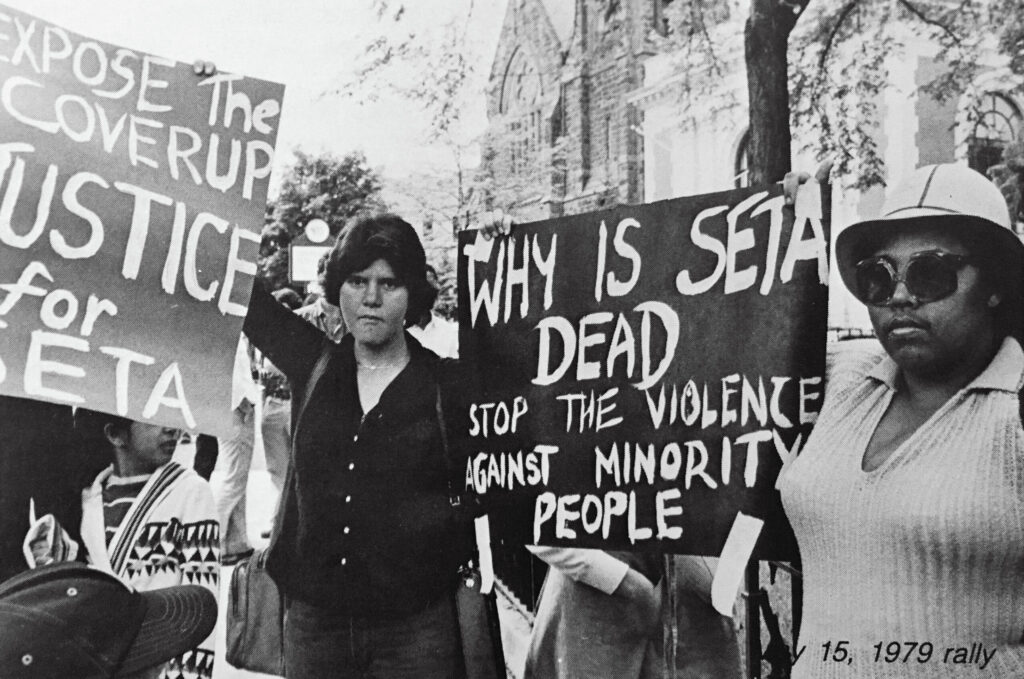
In May 1979, District Attorney Simons refused to reopen the Rampersad case despite public pressure. The Advocate responded with an editorial criticizing his decision in light of so many irregularities in the investigation and the inquest itself. The Daily Hampshire Gazette, which had defended the inquest and Simons, responded to The Advocate, deflecting any racial import. The Advocate responded to The Gazette the following month.
The Third World Women’s Task Force orchestrated a vigil on September 13, 1979. Coffins were carried through The Captain’s Table, where Seta had worked, and a candlelight vigil was held outside the Northampton Courthouse. The front page of the October issue of the Valley Women’s Voice was dedicated to Seta and the protest with “Did Justice Die With Seta?“
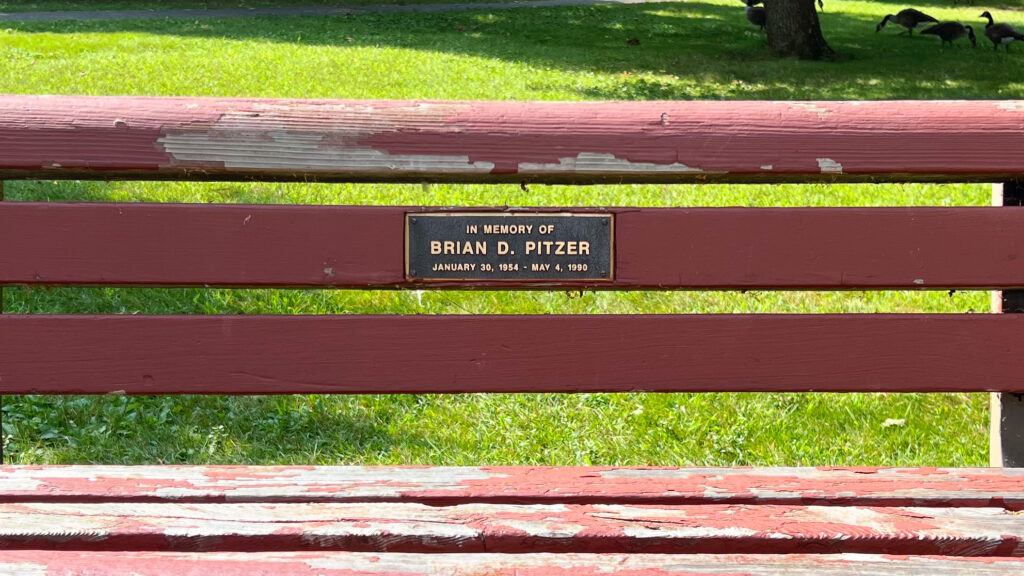
Brian Pitzer would later claim that he was stabbed when someone picked him up hitch hiking. He said it was because the driver was upset with the Seta case. Brian refused treatment for the wound, and later it seemed likely that he had hurt himself rather than having been attacked. He died in 1990. A memorial bench is dedicated to his honor at Look Memorial Park in Florence, MA.
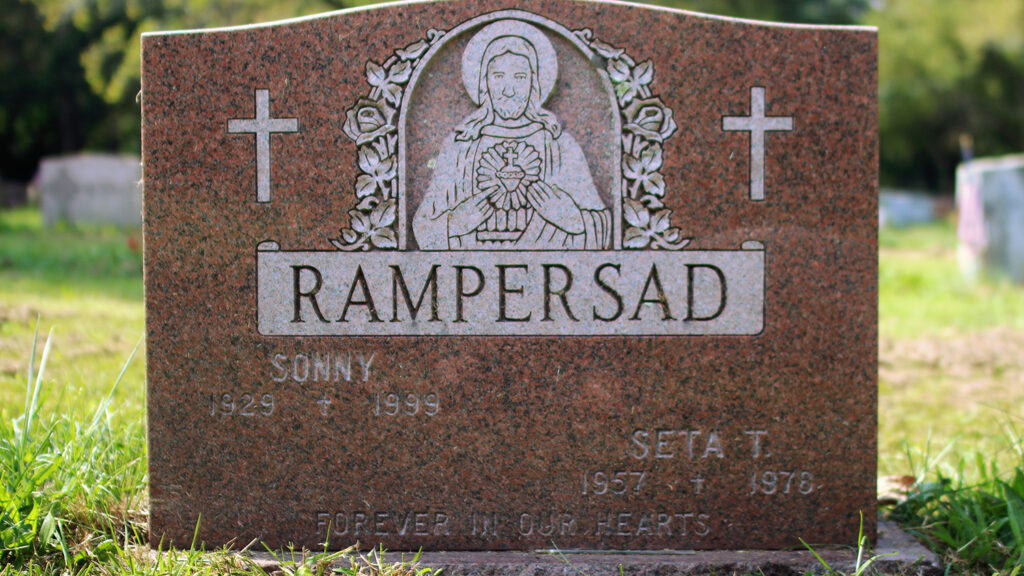
Sonny Rampersad, Seta’s dad, died on September 11, 1999. Sonny never filed a civil suit for the wrongful death of his daughter on account that sex had been a factor the night she died. He is buried with his daughter.
In the Summer of 2000, a local zine called VMag, short for Valley Magazine, dedicated an entire issue to Seta. Their team happened to meet the Rampersad family visiting Sonny and Seta’s grave. Their work was instrumental to this article.
Demetrios Konstantopolous, aka Jimmy the Greek, walked free. He had at least one other run-in with the law regarding one of his dancers, whom he was accused of physically and emotionally abusing. He sold the Castaway Lounge in 2014. Jimmy died at his home in Whately on June 15, 2023.
Method
I first heard Seta’s name as a whisper at work. I was working for UMass when a colleague in another office asked, given my interest in history, if I’d ever heard of the Rampersad case.
The project took three years of work in my spare time. First I found a mention of the case in the 1979 UMass yearbook, then walked through the Greenfield Recorder’s archives, followed by The Collegian. I found other sources at Forbes Library, the Northampton District Court Library, and online.
What I have added to this record is chiefly the arrangement of the medical examiner’s and pathologist’s testimony on the time of death, and the paramedics’ and undertaker’s observations of rigor mortis, which stand against the finding issued by Judge McGuane. Two matters deliberately outside the scope of this article are the reported presence of others at the party, and the litigation surrounding the owner of the Captain’s Table. Both deserve more than a paragraph.
Sources
1. 1978: Initial Coverage & Inquest Request
1. Woodcock, Chris. “Motel 6 Body Probe Continues.” Greenfield Recorder , September 14, 1978.
Published on September 14, 1978, in the Greenfield Recorder, this initial news report details the discovery of 20-year-old UMass student Seta Rampersad’s body at Motel 6 in South Deerfield on September 13, 1978. It represents contemporaneous reporting on the early investigation conducted by medical examiner Dr. John Olson and state police.
2. Recorder Staff et al. “Selected News Coverage on the Death of Seta Rampersad.” Greenfield Recorder , September 14, 1978–September 18, 1979.
This document gathers Greenfield Recorder news articles published between September 14, 1978, and September 18, 1979, covering Seta Rampersad’s death, police investigations, the inquest, and subsequent legal disputes. It provides contemporaneous reporting by journalists including Sean Horgan, Michael Gery, Richie Davis, and Neil L. Perry.
3. The Boston Globe . “RAMPERSAD.” Death notice. September 15, 1978.
Published on Friday, September 15, 1978, in The Boston Globe, this notice prints the official death announcement for Seta T. Rampersad. It represents contemporaneous death reporting listing her parents Sonny and Pearl Rampersad and funeral service details in Dorchester and Milton.
4. The Boston Globe . “Seta Misc Readings: Obituary Notice.” September 15, 1978.
This document compiles historical readings and an excerpted obituary notice for Seta Rampersad originally published in the Boston Globe on September 15, 1978. It functions as a retrospective historical compilation preserving original funeral and death notices.
5. Greenfield Recorder . “Woman’s Death Still Mystery.” September 15, 1978.
Published on September 15, 1978, in the Greenfield Recorder, this article reports that autopsy results remained inconclusive following the discovery of Seta Rampersad at Motel 6 on September 13, 1978. It represents contemporaneous reporting detailing police interviews with Captain’s Table co-workers and Deerfield Police Chief John Skroski.
6. Horgan, Sean, Renee Mobley, Carmen M. Cadiz, Suman Bohm, Mark Horan, Eliseo Garcia, Charles Bagli, Debra Roth Santa, and Fran Basche. “Selected Articles on the Seta Rampersad Case.” Massachusetts Daily Collegian , September 15, 1978–May 16, 1979.
This compilation of Massachusetts Daily Collegian articles spans September 15, 1978, to May 16, 1979, documenting Seta Rampersad’s death, the closed-door inquest, and student rallies. It offers contemporaneous student reporting featuring articles and commentary by Sean Horgan, Renee Mobley, Carmen M. Cadiz, Suman Bohm, and Charles Bagli.
7. Davis, Richie. “DA Seeks Inquest to Close Case.” Greenfield Recorder , October 20, 1978.
Written by Richie Davis on October 20, 1978, for the Greenfield Recorder, this article reports District Attorney John M. Callahan’s decision to request a closed judicial inquest into Seta Rampersad’s September 13, 1978 death. It constitutes contemporaneous coverage outlining autopsy findings of “undetermined causes”.
8. Recorder Staff. “Lawyer Charges ‘Neglect’ in Deerfield Death Mystery.” Greenfield Recorder , December 8, 1978.
Published on December 8, 1978 (despite its file title), this Greenfield Recorder article covers family attorney Ozell Hudson’s press conference revealing closed-door inquest testimony regarding Seta Rampersad’s September 13, 1978 death. It provides contemporaneous reporting on allegations of negligent misconduct against Demetrios Konstantopolous, Brian Pitzer, and Carol Newton.
2. 1979: Inquest Report, Media Investigations, & Activism
9. Perry, Neill, and Richie Davis. “Simons Releases Inquest Report.” Greenfield Recorder , January 31, 1979.
Written by Neill Perry and Richie Davis on January 31, 1979, for the Greenfield Recorder, this front-page article reports DA Thomas Simons’ release of Judge Allan McGuane’s inquest report into Seta Rampersad’s September 13, 1978 death. It provides contemporaneous coverage summarizing witness testimony from Demetrios Konstantopolous and Brian Pitzer while confirming no charges would be filed.
10. Horgan, Sean. “DA’s Decision Angers Rampersads.” Greenfield Recorder , February 1, 1979.
Published on February 1, 1979, in the Greenfield Recorder, this front-page news article reports District Attorney Thomas Simons’ official announcement closing the Seta Rampersad case following the inquest. It represents contemporaneous reporting quoting reactions from Mrs. Sonny Rampersad, attorney Ozell Hudson, and DA Simons.
11. O’Connell, Geoff, Bev Eaton, Gary Nielson, and Linda Matys. “A Death in Deerfield: The Unanswered Questions.” Valley Advocate , March 14, 1979.
Published on March 14, 1979, this complete issue of the Valley Advocate features an extensive cover story titled “A Death in Deerfield: The Unanswered Questions” regarding Seta Rampersad’s September 13, 1978 death. It contains contemporaneous investigative reporting authored by Geoff O’Connell, Bev Eaton, Gary Nielson, and Linda Matys based on the 647-page inquest transcript.
12–26. O’Connell, Geoff, Bev Eaton, Gary Nielson, and Linda Matys. “A Death in Deerfield: The Unanswered Questions” [Inquest Series Page Scans]. Valley Advocate , March 14, 1979.
These 15 page scans from the March 14, 1979 Valley Advocate (ScanPro0038.pdf through ScanPro0046b.pdf) provide detailed, section-by-section investigative analysis of the closed inquest transcript regarding Seta Rampersad’s September 13, 1978 death. They represent contemporaneous reporting analyzing timeline discrepancies, medical testimony, companion actions, and police evidence handling.
27. Committee Against Repression, and Third World Women’s Task Force. “Seta: A Symbol We Can’t Ignore.” Letter to the editor. Greenfield Recorder , April 30, 1979.
Published on April 30, 1979, in the Greenfield Recorder, this open letter to District Attorney Thomas Simons from two UMass groups urges a renewed investigation into Seta Rampersad’s September 13, 1978 death. It represents contemporaneous advocacy carrying the signatures of 20 community members including Bob Bohm, Suman Bohm, and Carmen Cadiz.
28. Greenfield Recorder . “Historical Greenfield Recorder Index (1979).” Archival compilation, April 30–September 18, 1979.
This document lists headlines and partial article text from the Greenfield Recorder published between April 30, 1979, and September 18, 1979. It acts as a contemporaneous reference document indexing news stories on District Attorney Thomas Simons, community letters, and media libel suits.
29. Greenfield Recorder . “Corrections.” May 8, 1979.
Published on May 8, 1979, in the Greenfield Recorder, this issue contains local news and a brief formal correction regarding inaccurate press release statements about a newspaper editor in the Rampersad case. It serves as a contemporaneous news sheet and correction notice.
30. Gery, Michael. “Probe Ends, Proof Said Lacking.” Greenfield Recorder , May 10, 1979.
Written by Michael Gery on May 10, 1979, for the Greenfield Recorder, this article reports that District Attorney Thomas Simons declined to reopen the probe into Seta Rampersad’s September 13, 1978 death. It constitutes contemporaneous reporting addressing allegations submitted by the Third World Women’s Task Force and Committee Against Repression.
31. Davis, Richie. “Groups Petition to Reopen Probe.” Greenfield Recorder , May 12, 1979.
Written by Richie Davis on May 12, 1979, for the Greenfield Recorder, this article reports on petition drives organized by UMass groups demanding that District Attorney Thomas Simons reopen the Seta Rampersad investigation. It offers contemporaneous coverage quoting spokeswomen Carmen Cadiz and Suman Bohm.
32. Third World Women’s Task Force, and Committee Against Repression. “Seta Rampersad Support Fund Needs Money.” Valley Advocate , May 16, 1979.
Published in May 1979, this notice requests contributions to the Seta Rampersad Support Fund organized by the Third World Women’s Task Force and the Committee Against Repression to force a reopening of the investigation into her September 13, 1978 death. It provides contemporaneous reporting on grassroots fundraising efforts centered on Seta Rampersad.
33. Griffith, Connie Marie, and Trevor Henley. “Death in Deerfield.” Letters to the editor. Valley Advocate , May 16, 1979.
This letters page features statements from readers Trevor Henley and Connie Marie Griffith criticizing Judge Allan McGuane and former District Attorney John Callahan over the September 13, 1978 death of 20-year-old UMass student Seta Rampersad. It offers contemporaneous commentary published in May 1979 regarding official negligence.
34. O’Connell, Geoff, Bev Eaton, Linda Matys, and Gary Nielson. “D.A. Tom Simons Turns Back on Death in Deerfield.” Editorial. Valley Advocate , May 16, 1979.
Published on May 16, 1979, this front-page editorial strongly attacks Hampshire-Franklin District Attorney Tom Simons for closing the investigation into Seta Rampersad’s September 13, 1978 death. It provides contemporaneous editorial reporting by journalists Geoff O’Connell, Bev Eaton, Linda Matys, and Gary Nielson.
35. Simons, Thomas G. “Rampersad Death: The District Attorney Finds ‘No Negligence.'” Greenfield Recorder , May 18, 1979.
Published on May 18, 1979, in the Greenfield Recorder, this item prints the complete text of District Attorney Thomas Simons’ official response concluding no criminal negligence occurred in Seta Rampersad’s September 13, 1978 death. It functions as a contemporaneous public record addressing community allegations.
36. Greenfield Recorder . “Students Admit Cross Burning.” May 22, 1979.
Published on May 22, 1979, in the Greenfield Recorder, this news page reports that two students admitted to a cross-burning incident outside an Amherst college dormitory. It constitutes contemporaneous reporting on regional news events and racial tensions in May 1979.
37. Valley Advocate . “COVERUP: JUSTICE for SETA.” May 23, 1979.
Despite its modern PDF header label, this item contains news coverage from May 1979 reporting on over 100 demonstrators marching on District Attorney Tom Simons’ office regarding Seta Rampersad. It represents contemporaneous reporting covering the May 1979 courthouse demonstration and regional political developments.
38. Valley Advocate . “‘Good Taste’ and ‘Death in Deerfield.'” Editorial. June 6, 1979.
Published on June 6, 1979, this Valley Advocate editorial defends its investigative reporting on Seta Rampersad’s September 13, 1978 death against criticisms from Daily Hampshire Gazette editor Edward Shanahan. It serves as contemporaneous press commentary discussing the 647-page inquest transcript, professional ethics, and District Attorney Tom Simons.
39. Valley Advocate . “Take Back The Night.” June 13, 1979.
Published on June 13, 1979, this front page of the Valley Advocate highlights the “Take Back The Night” rally addressing the regional crisis of assaults on women. It represents contemporaneous reporting on Pioneer Valley community activism in mid-1979.
40. Gullion, Laurie. “Group to Mark Woman’s Death.” Greenfield Recorder , September 7, 1979.
Written by Laurie Gullion on September 7, 1979, for the Greenfield Recorder, this news item reports on community plans for a demonstration marking the upcoming one-year anniversary of Seta Rampersad’s September 13, 1978 death. It offers contemporaneous reporting on activist preparations.
41. Perry, Neill. “UMass Student’s Death Remembered: Demonstration Marks Anniversary.” Greenfield Recorder , September 14, 1979.
Written by Neill Perry on September 14, 1979, for the Greenfield Recorder, this article covers a demonstration by over 100 protesters marking the one-year anniversary of Seta Rampersad’s September 13, 1978 death. It provides contemporaneous reporting on a rally outside the Northampton courthouse led by student groups and the National Conference of Black Lawyers.
42. Perry, Neil L. “DA Ordered to Answer 5 Questions in Libel Suit.” Greenfield Recorder , September 18, 1979.
Written by Neil L. Perry on September 18, 1979, for the Greenfield Recorder, this article reports that Superior Court Judge Kent B. Smith ordered District Attorney Thomas Simons to answer five questions in a $250,000 libel suit. It provides contemporaneous legal reporting on libel litigation filed by Register of Probate Robert Czelusniak.
43. Committee Against Repression. “Seta Rampersad Memorial Entry.” University of Massachusetts 1979 Yearbook , 1979.
Originally published on page 18 of the 1979 University of Massachusetts Yearbook, this retrospective text reviews Seta Rampersad’s life, her September 13, 1978 death at Motel 6, and the subsequent closed inquest. It represents retrospective student advocacy written by the Committee Against Repression detailing legal criticisms of DA Thomas Simons and naming companions Brian Pitzer, Carol Newton, and Demetrios Konstantopolous.
3. Retrospective Legal Reporting & Archival Research Lists
44. Gonter, Nancy H. “Lawyer’s Charges Pile Up.” The Republican (Springfield, MA), May 23, 1997.
Written by Nancy H. Gonter on May 23, 1997, for The Republican, this article reports on civil and criminal charges facing former attorney Charles Kulikowski Jr.. It represents retrospective coverage explaining Kulikowski’s failure to pursue a libel suit for Augustus Perfito against the Greenfield Recorder over its April 27, 1979 article concerning Seta Rampersad’s 1978 death.
45. Daily Hampshire Gazette (Northampton, MA). “Judge Ups Bail for Kulikowski: Ex-City Lawyer Also Ordered to Pay Additional $100,000.” May 24, 1997.
Published on May 24, 1997, in the Daily Hampshire Gazette, this article details legal proceedings against former lawyer Charles W. Kulikowski and a malpractice judgment awarded to former Captain’s Table owner Augustus Perfido. It is a retrospective report referencing Perfido’s 1981 libel suit tied to news coverage of Seta Rampersad’s September 13, 1978 death.
46. Biederman, David. “A Death in Deerfield: The Death of Seta Rampersad.” VMag (Valley Magazine), June/July 2000.
Written by David Biederman for the June/July 2000 issue of VMag (Valley Magazine), this 22-page investigative report re-examines the September 13, 1978 death of 20-year-old UMass student Seta Rampersad. It provides comprehensive retrospective reporting featuring new interviews with her mother Pearl Rampersad, sister Sandy Donnelly, former DA John Callahan, former DA Tom Simons, attorney Ozell Hudson, and legal expert John Thompson.


Why does this article never mention the Valley Advocate’s extensive investigation and coverage of this story? That paper played a prominent role in questioning the course of justice and calling attention to the case’s shoddy handling. Surely those reporters should be credited here.
I know more about this than I wish to.
That was no ‘Phantom party’, it was very real and involved some powerful people.
Why else would Brian wipe down the room? We have 3 people that admit to being in that room with Seta.
But it all gets wiped down?
That was to hide the other 5 or 6 people involved. It’s far deeper than this, and a coverup absolutely took place to hide that fact.
would you be willing to talk to me about what you know?
I was the publisher of VMag and would like to note that meeting up with Seta’s family at her gravesite still feels like a stunning coincidence, even after 25 years. The day was not an anniversary of any sort – not of her birth or death – just a random day that the VMag “team” (myself, the author, a photographer, a friend) chose because it aligned with our schedules. To arrive at the cemetery only to find Seta’s family on the day of their annual trek from Florida (itself not the same day each year) to visit the grave was more than jaw dropping awe, it truly felt as though an invisible hand brought us all together. It was amazing. After introducing ourselves to the Rampersad family – and sharing in the awe – we went out for dinner and later exchanged contact info. Sadly, Seta’s mother, was let down by the article. Not for its lack of detail into the story/case but because it didn’t lead to anyone’s conviction. Thank you for keeping Seta’s story alive.
I lived in Northampton at the time and remember how frustrating it was that no one was ever held accountable for Seta Rampersad’s death.